Friday, May 11, 2018

Wednesday, April 3, 2013
INTERNATIONAL CONFERENCE ON LITERATURE ATHENS GREECE
WOW! Ito ang isa sa magandang balita, natanggap ang 2
papel namin nina Sir Jomar Gonzales Adaya Sir
John Venson Villareal at
Mam Mayluck Malaga sa
International Conference on Literature sa Athens, Greece sa July 8-11, 2013,
kaya lang mangangailangan kami ng malaking halaga para makapunta kami sa
Greece. PANAWAGAN SA MGA MAYAYAMAN, MABUBUTI ANG KALOOBAN, MGA KAIBIGAN, AT
KAHIT SINO KA PA, KA-PUPIAN, KAKAPALAN NA NAMIN ANG MGA MUKHA NAMIN, PA-SPONSOR
NAMAN! Kung may mga kakilala rin kayo na pwede namin abutan ng sponsorship
letter, pa-PM naman. Narito ang mga acceptance letter:
ATHENS INSTITUTE FOR EDUCATION AND RESEARCH
8 Valaoritou Str., Kolonaki, 10671 Athens, Greece. Tel.: 210-36.34.210 Fax: 210-36.34.209
Email: atiner@atiner.gr URL: www.atiner.gr
Athens, 29 March 2013
ATHENS INSTITUTE FOR EDUCATION AND RESEARCH
8 Valaoritou Str., Kolonaki, 10671 Athens, Greece. Tel.: 210-36.34.210 Fax: 210-36.34.209
Email: atiner@atiner.gr URL: www.atiner.gr
Athens, 29 March 2013
Romeo Peña, Instructor, Jomar Adaya, Instructor
John Venson Villareal, Instructor, Mayluck Malaga, Instructor
Polytechnic University of the Philippines
Philippines
Our Ref: LIT2013/2894083
Dear Colleagues,
I would like to inform you that the selection committee has decided to invite you to speak at our 6th Annual International Conference on Literature, 8-11 July 2013, Athens, Greece on the topic of:
REFLECTIONS ON THE INTEGRATION OF POPULAR CULTURE IN THE WORKS/LITERATURE OF YOUNG BLOOD CREATIVE WRITERS FROM THE ACADEME IN THE PHILIPPINES
Please be prepared for an oral presentation of 15-20 minutes including discussion and visit the conference website:http://www.atiner.gr/literature.htm for more information. Confirm your participation by completing and sending the registration form before 29 April 2013 by fax, regular mail or email. The registration form can be downloaded from (http://www.atiner.gr/2013/REG-LIT.doc). For your convenience, a special conference rate has been arranged with a hotel. Please complete the registration form for the nights you want accommodation for. Reservations should be made as soon as possible as the offer only stands as long as rooms are available. The name of the hotel will be announced 1-2 weeks before the conference. ATINER will select one of the hotels available on the following list: http://www.atiner.gr/docs/Hotels_List.htm. If you need more information on the accommodation please send us an email (not to the hotel itself) at hotel@atiner.gr.
The conference’s social program is available athttp://www.atiner.gr/2013/SOC-LIT.htm. These academic events give the opportunity to our conference participants to further discuss the issues developed during the formal sessions and establish academic collaborations with other scholars from many different countries.
If you want your paper to be considered (peer reviewed) for publication, please submit your manuscript by 10 June 2013 following the paper guidelines, which can be downloaded from:http://www.atiner.gr/docs/Paper_Guidelines.htm. Papers cannot exceed 5000 words (everything included) and must be sent by email only. For more information, please see our abstract and paper publication policy athttp://www.atiner.gr/docs/Publication_Policy.htm. Please, do not fax your paper. In addition to your paper being considered for publication, the Institute publishes an abstract book with an ISBN number and a Conference Paper Series with an ISSN number. The last two publications come out immediately after the conference.
Please support ATINER by asking your library to order our publications from previous conferences, either as books or selected conference proceedings. Visit our publications website for contents and order forms (http://www.atiner.gr/docs/BOOK_PUBLICATIONS.htm).
I look forward to meeting you in Athens.
Sincerely,
Dr. Gregory T. Papanikos
President
ITO PA ANG ISA!
ATHENS INSTITUTE FOR EDUCATION AND RESEARCH
8 Valaoritou Str., Kolonaki, 10671 Athens, Greece. Tel.: 210-36.34.210 Fax: 210-36.34.209
Email: atiner@atiner.gr URL: www.atiner.gr
Athens, 29 March 2013
John Venson Villareal, Instructor, Mayluck Malaga, Instructor
Polytechnic University of the Philippines
Philippines
Our Ref: LIT2013/2894083
Dear Colleagues,
I would like to inform you that the selection committee has decided to invite you to speak at our 6th Annual International Conference on Literature, 8-11 July 2013, Athens, Greece on the topic of:
REFLECTIONS ON THE INTEGRATION OF POPULAR CULTURE IN THE WORKS/LITERATURE OF YOUNG BLOOD CREATIVE WRITERS FROM THE ACADEME IN THE PHILIPPINES
Please be prepared for an oral presentation of 15-20 minutes including discussion and visit the conference website:http://www.atiner.gr/literature.htm for more information. Confirm your participation by completing and sending the registration form before 29 April 2013 by fax, regular mail or email. The registration form can be downloaded from (http://www.atiner.gr/2013/REG-LIT.doc). For your convenience, a special conference rate has been arranged with a hotel. Please complete the registration form for the nights you want accommodation for. Reservations should be made as soon as possible as the offer only stands as long as rooms are available. The name of the hotel will be announced 1-2 weeks before the conference. ATINER will select one of the hotels available on the following list: http://www.atiner.gr/docs/Hotels_List.htm. If you need more information on the accommodation please send us an email (not to the hotel itself) at hotel@atiner.gr.
The conference’s social program is available athttp://www.atiner.gr/2013/SOC-LIT.htm. These academic events give the opportunity to our conference participants to further discuss the issues developed during the formal sessions and establish academic collaborations with other scholars from many different countries.
If you want your paper to be considered (peer reviewed) for publication, please submit your manuscript by 10 June 2013 following the paper guidelines, which can be downloaded from:http://www.atiner.gr/docs/Paper_Guidelines.htm. Papers cannot exceed 5000 words (everything included) and must be sent by email only. For more information, please see our abstract and paper publication policy athttp://www.atiner.gr/docs/Publication_Policy.htm. Please, do not fax your paper. In addition to your paper being considered for publication, the Institute publishes an abstract book with an ISBN number and a Conference Paper Series with an ISSN number. The last two publications come out immediately after the conference.
Please support ATINER by asking your library to order our publications from previous conferences, either as books or selected conference proceedings. Visit our publications website for contents and order forms (http://www.atiner.gr/docs/BOOK_PUBLICATIONS.htm).
I look forward to meeting you in Athens.
Sincerely,
Dr. Gregory T. Papanikos
President
ITO PA ANG ISA!
ATHENS INSTITUTE FOR EDUCATION AND RESEARCH
8 Valaoritou Str., Kolonaki, 10671 Athens, Greece. Tel.: 210-36.34.210 Fax: 210-36.34.209
Email: atiner@atiner.gr URL: www.atiner.gr
Athens, 29 March 2013
Jomar Adaya, Instructor, Romeo Peña, Instructor
John Venson Villareal, Instructor, Mayluck Malaga, Instructor
Polytechnic University of the Philippines
Philippines
Our Ref: LIT2013/2964089
Dear Colleagues,
I would like to inform you that the selection committee has decided to invite you to speak at our 6th Annual International Conference on Literature, 8-11 July 2013, Athens, Greece on the topic of:
ANALYSIS ON POP CULTURE IN THE SPACE OF FLASH NARRATIVE OR DAGLI IN THE PHILIPPINES
Please be prepared for an oral presentation of 15-20 minutes including discussion and visit the conference website:http://www.atiner.gr/literature.htm for more information. Confirm your participation by completing and sending the registration form before 29 April 2013 by fax, regular mail or email. The registration form can be downloaded from (http://www.atiner.gr/2013/REG-LIT.doc). For your convenience, a special conference rate has been arranged with a hotel. Please complete the registration form for the nights you want accommodation for. Reservations should be made as soon as possible as the offer only stands as long as rooms are available. The name of the hotel will be announced 1-2 weeks before the conference. ATINER will select one of the hotels available on the following list: http://www.atiner.gr/docs/Hotels_List.htm. If you need more information on the accommodation please send us an email (not to the hotel itself) at hotel@atiner.gr.
The conference’s social program is available athttp://www.atiner.gr/2013/SOC-LIT.htm. These academic events give the opportunity to our conference participants to further discuss the issues developed during the formal sessions and establish academic collaborations with other scholars from many different countries.
If you want your paper to be considered (peer reviewed) for publication, please submit your manuscript by 10 June 2013 following the paper guidelines, which can be downloaded from:http://www.atiner.gr/docs/Paper_Guidelines.htm. Papers cannot exceed 5000 words (everything included) and must be sent by email only. For more information, please see our abstract and paper publication policy athttp://www.atiner.gr/docs/Publication_Policy.htm. Please, do not fax your paper. In addition to your paper being considered for publication, the Institute publishes an abstract book with an ISBN number and a Conference Paper Series with an ISSN number. The last two publications come out immediately after the conference.
Please support ATINER by asking your library to order our publications from previous conferences, either as books or selected conference proceedings. Visit our publications website for contents and order forms (http://www.atiner.gr/docs/BOOK_PUBLICATIONS.htm).
I look forward to meeting you in Athens.
Sincerely,
Dr. Gregory T. Papanikos
President
John Venson Villareal, Instructor, Mayluck Malaga, Instructor
Polytechnic University of the Philippines
Philippines
Our Ref: LIT2013/2964089
Dear Colleagues,
I would like to inform you that the selection committee has decided to invite you to speak at our 6th Annual International Conference on Literature, 8-11 July 2013, Athens, Greece on the topic of:
ANALYSIS ON POP CULTURE IN THE SPACE OF FLASH NARRATIVE OR DAGLI IN THE PHILIPPINES
Please be prepared for an oral presentation of 15-20 minutes including discussion and visit the conference website:http://www.atiner.gr/literature.htm for more information. Confirm your participation by completing and sending the registration form before 29 April 2013 by fax, regular mail or email. The registration form can be downloaded from (http://www.atiner.gr/2013/REG-LIT.doc). For your convenience, a special conference rate has been arranged with a hotel. Please complete the registration form for the nights you want accommodation for. Reservations should be made as soon as possible as the offer only stands as long as rooms are available. The name of the hotel will be announced 1-2 weeks before the conference. ATINER will select one of the hotels available on the following list: http://www.atiner.gr/docs/Hotels_List.htm. If you need more information on the accommodation please send us an email (not to the hotel itself) at hotel@atiner.gr.
The conference’s social program is available athttp://www.atiner.gr/2013/SOC-LIT.htm. These academic events give the opportunity to our conference participants to further discuss the issues developed during the formal sessions and establish academic collaborations with other scholars from many different countries.
If you want your paper to be considered (peer reviewed) for publication, please submit your manuscript by 10 June 2013 following the paper guidelines, which can be downloaded from:http://www.atiner.gr/docs/Paper_Guidelines.htm. Papers cannot exceed 5000 words (everything included) and must be sent by email only. For more information, please see our abstract and paper publication policy athttp://www.atiner.gr/docs/Publication_Policy.htm. Please, do not fax your paper. In addition to your paper being considered for publication, the Institute publishes an abstract book with an ISBN number and a Conference Paper Series with an ISSN number. The last two publications come out immediately after the conference.
Please support ATINER by asking your library to order our publications from previous conferences, either as books or selected conference proceedings. Visit our publications website for contents and order forms (http://www.atiner.gr/docs/BOOK_PUBLICATIONS.htm).
I look forward to meeting you in Athens.
Sincerely,
Dr. Gregory T. Papanikos
President
Wednesday, October 17, 2012
WIKANG FILIPINO: HININGA, KAPANGYARIHAN AT PUWERSA
(Pangalawang Gantimpala, Gawad Komisyon sa Sanaysay 2012 ng Komisyon sa Wikang Filipino)
ni Romeo Palustre Peña
“Parang
hininga ang wika, sa bawat sandali ng buhay natin ay nariyan ito.
Palatandaan ito na buhay tayo, at may kakayahang umugnay sa kapwa nating
gumagamit din dito.”
—Bienvenido
Lumbera
Kapangyarihan ang wikang
Filipino sa Pilipinas. Kapangyarihan ang sariling wika. Isa ang sariling wika
sa bumubuo ng ating pagkatao. Nang dahil sa sariling wika, nagkakaroon tayo ng
tiyak at tunay identidad na hindi hiram sa iba. Nagiging ganap ang ating
pagkatao sapagkat malinaw ang nagbunsod nito—ang sariling wika at kultura.
Nagiging malaya tayo sa lipunang ating ginagalawan dahil ganap ang ating
pagkatao. Nagiging lubos ang kapangyarihan na sumasaklaw sa ating kamalayan
kung lubos din nating natatanggap ang sariling wika. Sang-ayon ito sa sinabi ni
Bienvenido Lumbera na ganito: “Sa pagtanggap natin sa wika, pumapaloob tayo sa
isang lipunan at nakikiisa sa mga taong naroon. Samakatuwid, ang kamalayan
natin bilang indibidwal ay karugtong ng kamalayan ng iba sa lipunan. Kapag may
kapangyarihang sumakop sa kamalayan ng kapwa natin sa lipunan, kasama tayong
napapailalim sa nasabing kapangyarihan.”
Ang sariling wika ay hindi
nakababawas ng katalinuhan at katanyagan kung gagamitin sa iba’t ibang larangan.
Kung ang usapin ay karunungan, maraming nag-aakala na mahina ang mga Filipinong
hindi nagsasalita ng wikang dayuhan partikular na ang mga taong hindi
nakapagsasalita ng matatas sa Ingles. Madalas silang maparatangang walang alam
o mas masakit, tinataguriang bobo. Isa itong masaklap na pangyayari. Ngunit
humihina na ang ganitong pagpaparatang dahil ginagamit ang wikang ito ng
kasalakuyang Pangulo at hindi naman ito nakabawas ng katalinuhan at katanyagan.
Sa kanyang mga talumpati at opisyal na pakikipagtalastasan sa taumbayan, buhay
na buhay ang wikang Filipino tulad ng pagsasabi niya sa kanyang SONA na malakas
ang bansang Pilipinas. Hindi ba’t napakaliwanag ang landas na tatahakin kung
kasabay ng malakas na Pilipinas ay malakas rin ang Filipino bilang matatag na
wikang pambansa?
Ang mga
Balakid sa Biyahe ng Wikang Filipino
Sa kabila ng pagpapatatag at
malawakang paggamit ng wikang Filipino, buhay na buhay pa rin ang maraming
isyung nagpapahina sa ating wikang pambansa. Mga dati nang isyung nagiging
dahilan kung bakit hindi umusad ang biyahe nito. Una na rito ay ang hindi
maayos na pamamahala ng edukasyon sa ating bansa at karaniwang nakakiling ang
mga administrador ng mga paaralan at pamantasan sa wikang Ingles dahil ito raw
ang wika ng mundo.
Pangalawa ang uri ng trabaho
na laganap sa Pilipinas, ang sunod-sunod na pagsulpot ng mga Business Process
Outsourcing (BPO) o mga call center na nangangailangan ng mga Pilipinong sanay
magsalita ng Ingles.
Pangatlo ang kakitiran ng
pag-iisip ng maraming edukador na hindi maaaring maging wikang panturo ang
pambansang wika. Hindi ito maaari sa edukasyon sa Pilipinas. Lagi nilang
sinasabi na Ingles lamang ang wika ng karunungan lalo na sa Agham at
Matematika. Dati pa itong isyu na hindi pa rin nila matanggap ang sagot dahil
nakabaling pa rin ang kanilang paningin sa wika ng mga dayuhan.
Pang-apat na isyu, ang
napakababang pagtingin ng mga mambabatas, maraming opisyal ng pamahalaan at
ilang kolonyal na Pilipino sa wikang Filipino. Marami sa kanila ang may maling
haka na wala itong lakas at hindi matatag para umangkop sa pangangailangan ng
Pilipinas sa maraming larangan, medisina, batas, enhinyerya at iba pang
malalaking larangan.
At ang huling isyu, kulang na
kulang daw sa mga sanggunian at kakaunti ang naisasaling karunungan mula
sa banyagang wika tungo sa wikang Filipino na kailangang–kailangan ng mga
estudyanteng Pilipino.
Ilan ito sa nagiging dahilan
kung bakit natatrapik ang biyahe ng wikang Filipino. Paulit-ulit na lamang ang
ganitong isyu na ipinupukol ng mga Pilipinong mahina ang pagkilala sa sariling
wika sa ating bansa. Kaya paulit-ulit na natatrapik ang ating identidad bilang
Pilipino.
Kalbaryo ng
Wikang Pambansa
Matinding kalbaryo ang sinapit
ng wikang Filipino lalo na ang nilagdaan sa panahon ng nakalipas na
administrasyong Macapagal-Arroyo ang Executive Order 210 (Establishing the
Policy to Strengthen the Use of English Language in the Educational System).
Pumasa rin sa kongreso ang House Bill 4701 (An act to Strengthen and Enhance
the Use of English as the Medium of Instruction in Philippine Schools) na
nagligaw sa wikang pambansa para humina at mawalan ng kabuluhan sa edukasyon sa
Pilipinas.
Totoo na ang Ingles ang wika
ng mundo para magkaunawaan ang iba’t ibang lahi sa daigdig ngunit hindi totoo
na wikang Ingles ang wika ng karunungan sa bansang may sariling kultura at
kabihasnan, lalo na’t ang bansang ito ay may sariling wika. Baluktot ang daang
tinutumbok ng mga Pilipinong hanggang sa kasalukuyan ay nagsusulong na sa
Ingles matatamo ang ganap na pagkatuto.
Kailangan pa ba ng maraming
sarbey na magpapatunay na hindi sa Ingles ganap na matututo ang mga Pilipino,
samantalang malinaw na sa SWS Survey noong 1993 na 18 porsyento lamang ng mga
Pilipino ang may ganap na kadalubhasaan sa paggamit ng wikang Ingles at
karamihan pa sa kanila'y lumaki sa Amerika at bumalik lamang dito sa Pilipinas.
Hindi pa yata sapat na batayan ito para mapanuto ang mga maka-wikang dayuhan.
Sa sumunod na sarbey ng SWS na may kinalaman sa Filipino noong December 1995,
sa tanong na gaano kahalaga ang pagsasalita ng Filipino? Lumabas sa sarbey na 2
sa bawat 3 Pilipino ang nagsasabing mahalagang-mahalaga ang pagsasalita ng
Filipino. Lumabas din na 71 porsyento ng nasa Luzon, 55 porsyento ng nasa
Bisaya at 50 porsyento ng nasa Mindanao ang sumagot na mahalagang–mahalaga ang
pagsasalita ng Filipino. Sapat itong batayan na mahalagang-mahalaga ang wikang
Filipino saanmang panig ng Pilipinas. Sa sarbey ring ito nalaman ang pulso
hinggil sa wikang Filipino ng mga Pilipinong nasa uring ABC (o mga mayayaman,
angat at maykaya sa buhay), 73 porsyento sa kanila ang nagsabing
mahalagang-mahalaga ang pagsasalita ng Filipino. Matatag itong basehan na hindi
lamang ang nasa uring D at E (o mga mahihirap at hikahos sa buhay)
mahalagang-mahalaga ang Filipino. Bilang dagdag, sa sarbey rin ng SWS noong
abril 8-16 1998, tinanong ang 1,500 na Pilipino sa iba’t ibang panig ng
Pilipinas kung ano ang unang wika nila sa tahanan, 35 porsyento ang ang nagsabi
na Filipino, 24 porsyento ang nagsabi na Cebuano, 11 porsyento ay Ilonggo, 8
porsyento ay Kapampangan, 5 porsyento ay Ilokano, samantalang 1 porsyento
lamang sa buong bansa ang nagsabi na Ingles ang una nilang wika sa
tahanan. Kung ang resulta ay pumapabor sa Filipino bilang unang wika sa
tahanan, hindi ba’t sa bansang Japan, South Korea, Belgium, Czeck Republic at
Slovakia, ang wikang ginagamit nila sa edukasyon ay ang unang wika na natutuhan
nila sa tahanan at ang wikang kanilang ginagamit sa pang-araw-araw na buhay.
Mapapansing sila ang nanguna sa Third International Maths and Science study
noong 1997—ibig sabihin magagaling ang kanilang estudyante sa larangan ng Agham
at Matematika. Ang kanilang sikreto, gumagamit sila ng wikang hindi nalalayo sa
kanilang identidad–ang sarili nilang wika.
Bukod sa SWS, mapapansing
kahit sa pag-aaral ng isang iskolar na Hapones na si Koichiro Nakahara noong
Enero 2005 malinaw na hindi Ingles ang namamayaning wika sa Pilipinas. Aniya,
“The national language of the Philippines is Filipino. The official languages
are Filipino and English. English has been being used there since the beginning
of the 20th century but it has not been easy to popularize by the Filipino
there.” Lumalabas sa kanyang sarbey na may 139 na Filipinong tagatugon, 35
porsyento ang nagsabing dapat Filipino lamang ang opisyal na wika sa Pilipinas
samantalang 2 porsyento lamang ang nagsabi na dapat Ingles lang at 61 porsyento
ang nagsabi na Filipino at Ingles. Pinatunayan din ng resulta ng kanyang sarbey
na hindi pareho ang Tagalog at Filipino dahil lampas sa kalahati o 51
porsyento ang nagsabi na magkaiba ito.
Kung mapapanood ang
dokumentaryo ng I–Witness na may pamagat na “Don’t English Me” ni Howie
Severino. Nabanggit doon na lampas sandaang taon na nating inaaral ang wikang
Ingles ngunit bakit haggang sa kasalukuyan ay tila walang katatasan sa
pagsasalita ng wikang Ingles ang mga Pilipino. Pamali-mali pa rin ang marami sa
atin sa pagbaybay ng salitang Ingles. Ipagdidiinan naman ng mga maka-Ingles na
hindi raw kasi siniseryoso ng maraming Pilipino ang pag-aaral ng wikang Ingles
kaya walang ganap na pagkatuto. Baluktot ang kanilang punto. Hindi kasi natural
na dumadaloy sa kaisipan ng mga batang Pilipino ang dayuhang wika kaya mahirap
maging matatas sa paggamit ng wikang iyon. Nahihirapan ang isang batang
nag-uumpisa pa lamang ng pag-aaral sa elementarya na maunawaan ang leksyong
pinag-aaralan nila sa klase lalo na kung itinuturo ito sa wikang hindi
niya nakasanayan o nakagisnan. Nagreresulta tuloy ito ng mataas na drop-out
rate, tinatamad nang mag-aral ang mga bata dahil hindi naman lubos na
nauunawaan ang wika ng guro lalo na sa Agham at Matematika. Sa pagtataya nga sa
kasalukuyan, sa 100 batang tumutuntong sa elementarya, 70 porsyento lamang ang
nakatatapos. Sa mga nagtapos ng elementarya, 90 porsyento ang makapapasok sa
mataas na paaralan at paglipas ng apat na taon ay 46 porsyento lamang ang
magmamartsa at sila lamang ang makatutungtong sa mga unibersidad o kolehiyo.
Mapapansing wala pa sa kalahati ang magtatapos sa kolehiyo. Ang masama nito,
marami sa mga hindi nakapag-aral ang nagiging kriminal at nagiging problema ng
bansa. Ang mga nagtuloy naman sa pag-aaral ay masasabing hilaw ang pagkatuto,
kung pag-uusapan ang wika—hindi na matatas sa wikang nakagisnan ay unti-unting
nalimutan at hindi na ito napahalagahan. Mali kasi ang sistema ng edukasyon sa
Pilipinas, bata pa lamang ay isinusubo na ang wikang dayuhang mahirap maunawaan.
Wala naman talaga sa wikang
dayuhan ang pagkatuto ng mga Filipino kundi nasa sariling wika. Pagpapatunay
nga ng isang edukador na Canadian na si Phil Bartle, “Sa pag-aaral ng basikong
literasiya, ang wikang gagamitin ay base sa kung ano ang karaniwang
naiintindihan at alam ng pamayanan. Walang isang wika ang pinakamahusay kaysa
sa iba.” Kung babalikan din natin ang kasaysayan ng Pilipinas, nang ipinag-utos
ng mga Amerikano noong 1901 na gawing opisyal na wikang panturo ang wikang
Ingles sa mga paaralan sa Pilipinas, makalipas lamang ang dalawampu’t limang
taon ay nabatid agad ng Amerikano sa pamamagitan ng pag-aaral ng Monroe
Educational Survey Commission na hindi naging matagumpay ang pagkatuto ng
mga Pilipino gamit ang wikang Ingles sa kanilang pag-aaral. Dahil dito
ipinag-utos din noong 1931 na wikang vernakular na ang gagamiting wikang
panturo sa elementarya.
Matagal na dapat nating alam
na ang wikang dayuhan ang isa sa dahilan ng pagkaligaw nating mga Pilipino sa
daan ng karunungan. Noon pa sinasabi at ipinaalala ng isa pang Pambansang
Alagad ng Sining para sa Panitikan na si Virgilio Almario na,
“Kailangang-kailangan na natin ang Filipino sa edukasyon at opisyal na
talastasan. Pero ayaw nating harapin ang tawag ng taumbayan.”
Pagsakay sa
Tatag ng Filipino Bilang Wika ng mga Pilipino
Umiiral sa realidad sa
Pilipinas na ang Filipino ay wikang panlahat. Nandyan ito, umiiral at ginagamit
sa araw-araw na pakikipagtalastasan ng mga Pilipino. Mga Pilipino ang kusang
tumanggap nito bilang wikang pambansa at naging katangi-tangi ang tatag nito
dahil ito ang wika ng lipunang Pilipino. Kaugnay ito sa sinabi ni Pamela
Constantino na, “Ang anumang kapangyarihan o puwersa ng wika ay itinalaga ng
institusying sosyal.” Hindi maitatangging malakas sana ang puwersa at
kapangyarihan ng wikang Filipino sa maraming larangan tulad ng edukasyon,
batas, agham, teknolohiya at iba pa, ang kaso pinahihina at binabansot ng
paniniwala ng nagkukunwang edukado at maraming politiko sa ating bansa.
Isang simpleng sitwasyon ang
maaaring maging halimbawa na maraming nagkukunwang edukado ang salat pa rin ang
kaalaman pagdating sa usapin hinggil sa ating sariling wika. Sa panahon na
nililitis si dating Presidente Joseph Estrada sa kasong pangungurakot. May
isang sitwasyon na nagpapakita ng maling pagtanaw sa wika ng mga mambabatas sa
Pilipinas kaya hindi ito maisulong nang husto bilang wika sa larangan ng batas.
Noong tinanong ni Hilario Davide (isang Cebuano), ang saksing si Emma Lim kung
anong wika ang nais niyang gamitin sa pagtestimonya, sumagot si Lim na sariling
wika ang gagamitin niya—ang Tagalog. Nakapagtataka ang sinabi ni Davide na wala
silang interpreter mula Tagalog tungong Ingles, sa Filipino tungong Ingles ay
mayroon. Tila hindi batid ni Davide ang pinagdaanang kasaysayan ng wikang
Filipino. Dahilan kaya ang pagiging Cebuano niya? Ngunit nang magsalita si
Senador Franklin Drilon na isang Ilonggo, sabi niya, hindi na kailangan ng
interpreter sapagkat lahat naman sila ay mauunawaan ang testimonya kahit sa
Tagalog.
Nabanggit din ni Constantino
na taglay ng wika ang kakayahang baguhin ang paniniwala ng isang indibidwal. Sa
pakikipag-ugnayan gamit ang wika, maraming bagay ang maaaring magbago.
Kunsabagay, marami nang pangyayari sa Pilipinas na kinakitaan ng malaking
pagbabago tungo sa pagsusulong ng wikang Filipino.
Ang matibay na halimbawa ay
noong Agosto 20, 2007, tatlong korte sa Lungsod ng Malolos ang nagdesisyong
gumamit ng Filipino sa paglilitis upang maisulong ang pambansang wika.
Labindalawang istenograpo mula sa hukuman 6, 80 at 81 bilang modelong korte
gamit ang wikang pambansa ang sumailalim sa pagsasanay sa Marcelo H. del
Pilar College of Law ng Bulacan State University bilang pagsunod sa direktiba
ng Korte Suprema ng Pilipinas hinggil sa paggamit ng Wikang Filipino sa
istenograpiya. Pangarap noon ng dating Punong Mahistrado na si Reynato Puno na
pati sa Laguna, Cavite, Quezon, Nueva Ecija, Batangas, Rizal at Metro Manila ay
maipatupad ang paggamit ng sariling wika sa paglilitis.
Dati pa man, sa sanaysay ni
Virgilio Almario na may pamagat na “Filipino ang Filipino” nabanggit na niya ang
maraming pagsisikap at eksperimento sa paggamit ng Filipino sa gawaing
akademiko. Aniya, maraming gurong pasimuno sa mga unibersidad, lalo na sa UP,
Ateneo de Manila, at De La Salle. Nangunguna raw si Dr. Virgilio Enriquez sa
mga orihinal na saliksik sa sikolohiya sa wikang Filipino. Itinuro ni Fr. Roque
Ferriols ang pilosopiya sa Filipino. Isinalin ni Judge Cesar Peralejo ang
kodigo sibill at kodigo penal. Lumikha ng diksyonaryo sa kemika si Dr.
Bienvenido Miranda at sa Medisina si Dr. Jose Reyes Sytangco. May libro sa
ekonomiks si Dr. Tereso Tullao, Jr. sa wikang Filipino. May mga nagtuturo ng
matematika sa Filipino. At marami nang jornal at monograp sa iba’t ibang
disiplina na nakalathala sa Filipino. Kaya hindi totoo na kulang na kulang sa
sanggunian at kakaunti ang naisasaling karunungan mula sa banyagang wika tungo
sa wikang Filipino. Katunayan, patuloy ang Sentro ng Wikang Filipino ng
Unibersidad ng Pilipinas sa paglalathala at pagpondo sa mga aklat na nasa
Filipino. Nasabi na rin dati pa ni Almario, “Kung ang usapin ay ang paglilimbag
ng mga materyales sa pag-aaral na nakasulat sa sariling wika, walang demand
kaya hanggang ngayo’y walang pabliser na nagpapasimuno sa paglalathala ng aklat
sa wikang Filipino sa iba’t ibang larangan.”
Ang lahat ng nabanggit na
halimbawa ng pagsisikap tungo sa ikauunlad ng pagkatuto sa iba’t ibang larangan
ay dahil sa puwersa at kapangyarihan ng wikang umiiral at nandyan lang. Hindi
na dapat nating ipagtaka kung paano nagawa ang pagsasalin at pagpapabukal ng
karunungan sa ibat’ ibang larangan gamit ang wikang Filipino. Angkop na angkop
ito sa pananaw ni Umberto Eco sa kanyang sanaysay na “Language, Power, Force”
binanggit niya, “We
must not be amazed then to hear people say that the given language is power...
because outside the given language there is nothing.”
Pagtahak at
Pagtalunton sa Wika at Edukasyon sa Pilipinas
Naging pugad ng anomalya ang
edukasyon sa Pilipinas sa mga nakalipas na taon. Naging gatasan ito ng
ilang opisyal ng gobyerno na naging mitsa ng panganganib ng kalidad ng
edukasyon ng mga Pilipino. Ilan sa anomalya ng DepEd ay ang noodles scam noong
2007, ang noodles na nagkakahalaga ng 18 pesos bawat isa. Ang textbook scam na
isiniwalat ni Antonio Go kung saan bumili ang gobyerno ng mga aklat na hindi dumaan
sa maayos na bidding at ebalwason na nagdulot ng mababang uri ng mga aklat
ngunit napakamahal ang presyo. Nakasasagabal ang ganitong pangyayari sa
Pilipinas upang maabot natin sa taong 2015 ang inihain ng United Nations na
Education for All (EFA) o Edukasyon para sa Lahat, higit pa yatang lumalala ang
baku-bakong landas na tinatahak ng edukasyon sa Pilipinas. Kahit bumuo noong
2007 ang nakaraang administrasyong Macapagal-Arroyo sa pamamagitan ng Executive
Order 652 ang Presidential Task Force on Education (PTFE) upang matugunan ang
EFA, wala itong nagawa dahil patuloy na bumagsak ang literacy rate o antas ng
pagkatuto ng mga Filipino. Sa datos nga ng NSO noong 2011 apat sa sampung
kabataan ang hindi marunong bumasa at sumulat.
Batay sa mga datos na nakalap
ni Dr. Edberto Villegas, sa panahon ni Macapagal-Arroyo, kalunos-lunos ang
kalagayan ng mga estudyante at guro sa mga pampublikong paaralan sa Pilipinas.
Nasaliksik niya na batay mismo sa estadistika ng gobyerno, may kakulangan ng
49, 000 na klasrum at may 2, 381, 943 na mga desk/armchairs sa ating mga
paaralan. Ang ratio ng bilang ng libro sa mga estudyante ay 0.33 sa mga
pampublikong paaralang pang-elementarya at 0.6 sa hayskul. Nananatili rin ang
kababaan ng sahod ng mga guro ayon sa datos ng Alliance of Concerned
Teachers o ACT. Ang 500,000 guro sa elementarya at sekondaryang pampublikong
paaralan ay sumasahod lamang mula 4, 000 hanggang 6, 000 bawat buwan.
Bukod sa mga nabanggit na mga
anomalya at suliranin sa edukasyon. Nananatiling suliranin sa larangang ito ang
hindi pagtanggap ng maraming edukador sa wikang Filipino bilang wikang panlahat
at wikang panturo.
Ayon kay Bienvenido Lumbera,
“Sa kasalukuyan, nagkapuwang na ang wikang Filipino sa kurikulum. Hindi pa ito
ang kinikilalang wikang panturo, pero may lugar na ito sa paaralan. Nakapasok
na sa akademya ang wika ng masa. Bagamat ang marami sa mga maykapangyarihan ay
nagmamatigas pa rin na sa Ingles lamang nagaganap ang tunay na edukasyon ng
kabataang Filipino.” Sa obserbasyong ito ni Lumbera, ang lakas at
kapangyarihan ng sariling wika sa Pilipinas ay pinipigilan pa rin ng mga
maykapangyarihan dahil nakabaling sila sa dayuhang wika. Tila bulag ang mga
Pilipinong nasa kapangyarihan at kolonyal mag-isip kung kaya’t nananatiling
suliran sa edukasyon hanggang sa kasalukuyan ang wikang panturo.
Ang isa pang mabigat na isyu,
hindi magaganap ang pagsupling ng kontra-kolonyal na wika at edukasyon kung ang
laganap na trabaho sa Pilipinas ay Business Process Outsourcing (BPO) o mga
call center. Dahil sa trabahong ito, lumikha ng mga programa ang maraming
unibersidad na magpapalakas sa wikang Ingles at ang mga kolehiyo at unibersidad
na may programang BSE English at AB English ay hindi na tumuon sa
pangangailangan ng Pilipinas na humubog ng mga magiging edukador sa hinaharap,
itinuon at nakapadron
ang mga kurikulum sa pangangailangan ng mga call center na sa loob nito’y mga
Pilipinong naglilingkod sa mga dayuhan. Masaklap kung iisipin na maraming mga
kolehiyo at unibersidad sa ating bansa ang hindi naghahain ng mga programang
nagsusulong at nagpapalakas ng identidad at diwang Filipino gaya ng mga
programang BSE Filipino, AB Filipinolohiya, Araling Pilipino na pinalalakas na
lamang ng ilang unibersidad sa ating bansa. Kung may mga trabaho nga lang sana
tumutugon sa pangangailangan ng mga Pilipino, hindi sana nagiging ganito ang
sitwasyon ng mga institusyong pang-edukasyon.
Ang Tatag
ng Wikang Filipino, Lakas ng Pagka-Pilipino
Sa napakaraming isyu tungkol
sa wika at edukasyon sa Pilipinas, mababakas naman kahit papaano sa sinasabing
tuwid na landas ng kasalukuyang administrasyong Aquino ang kontra-kolonyal na
wika at edukasyon. Huwag nga lang sana itong maging wang-wang kundi maipatupad
din ayon sa kagustuhan ng kanyang nga boss—tayong mga Pilipino. Bukod sa
pambansang programa niya kontra-korupsyon, ang kanyang pambansang adyenda sa
edukasyon para sa ating bansa ay bumabaling sa Filipino. Ayon sa DepEd, sa
kasalukuyan napigilan na ang ugat ng korupsyon sa kanilang ahensya at tumuon
sila sa pagpapataas ng edukasyong primarya. Nais nilang “bawat bata, mambabasa”
sa unang grado, sa ganitong punto mapapataas ang antas ng literasiya sa ating
bansa. Inuumpisahan na rin ang pagbabalik ng maayos na ebalwasyon sa mga
librong gagamitin sa paaralan upang makatiyak na dekalidad ito at hindi
nahahaluan ng korupsyon. Dinirinig na rin ayon sa DOLE ang dagdag na umento sa
sahod ng mga guro. Huwag lang sana itong dinggin kundi dagdagan na ng
makakasapat sa pang-araw-araw na pangangailangan ng guro sa kasalukuyan. Ayon
din sa nakaraang SONA ng administrasyong Aquino, bumaba ang bilang ng walang
trabaho sa Pilipinas. Magandang indikasyon ito ng pagbabago, pero sana ang idinadagdag
na trabaho ay Pilipino ang nakikinabang hindi laging dayuhan na lang. Malinaw
rin ang papel na tinatahak ng wikang pambansa na kasama sa adyenda ni Aquino sa
edukasyon, makatwiran lamang na gamitin ang sariling wika bilang midyum ng
pagtuturo sa ating bansa. Palalakasin ang paggamit nito sa Agham at Matematika
upang makamit ang kahusayan sa larangang ito. Ang pananaw niya sa wika ay
ganito: Matuto ng Ingles at umugnay sa daigdig, matuto ng Filipino at umugnay
sa ating bansa at panatilihin ang sariling wika at umugnay sa pamana ng
lahi.
Sa landas na tinatalunton
natin bilang mga Pilipino, dapat magkaisa tayo. Tigilan na ang kolonyal na
pag-iisip na nagpapabagal sa pag-unlad ng identidad at karunungan nating mga
Pilipino. Kung may naiaambag man ang kasalukuyang administrasyon sa
pagpapalakas ng sariling wika, huwag lang doon umasa, higit dapat tayong maging
malakas bilang mga Pilipino. Magiging malakas tayo kung mananatiling matatag
ang ating sariling wika dahil idiniin ni Lumbera, “Parang hininga ang wika, sa
bawat sandali ng buhay natin ay nariyan ito.”
MGA
SANGGUNIAN:
Almario, Virgilio S. (1997). Tradisyon at Wikang
Filipino. Lungsod ng Quezon: Sentro ng Wikang Filipino.
Aquino, Benigno Simeon III S.
(2010) salin ni Roberto T. Añonuevo. 10 Ways to Fix
Education in the Philippines nasa http://alimbukad.com.
Bartle, Phil. (2008) salin ni
Myla Burke. Mga
Prinsipyo ng Kaalaman sa Pagbasa at Pagsulat nasa http://www.scn.org/mpfc/modules/lit-prtt.htm.
Constantino, Pamela C. (1996).
Wika Bilang
Kasangkapang Panlipunan: Wikang Pambansa Tungo sa Pangkaisipan at
Pang-ekonomikong Kaunlaran nasa Mga Piling Diskurso sa Wika at Lipunan.
Pamela C. Constantino at Monico M. Atienza, mga ed. Lungsod ng Quezon:
University of the Philippines Press.
Eco, Umberto. (1986). Language, Power,
Force nasa Travels in Hyperriality: Essays translated from Italian by
William Weaver. Great Britain: Picador
Lumbera, Bienvenido. (2007). Ang Wika ay
Kasangkapan ng Maykapangyarihan: Ang Wika Bilang Instrumentong Politikal
nasa http://avhrc-kultura.blogspot.com.
Nakahara, Koichiro. (2005). Review of Some
Literatures and Results of Survey on English and Filipino in the Philippines
nasa http://opac.kanto-gakuin.ac.jp.
Villegas, Edberto M. (2004). Ang Sistema ng
Edukasyon sa Pilipinas nasa
http://www.bulatlat.com/news/4-6/4-6-edukasyon.html.
Thursday, September 29, 2011
(Sagutin ito!) Language, Learning, Identity, Privilege
By JAMES SORIANO
August 24, 2011, 4:06am
MANILA, Philippines — English is the language of learning. I’ve known this since before I could go to school. As a toddler, my first study materials were a set of flash cards that my mother used to teach me the English alphabet.
My mother made home conducive to learning English: all my storybooks and coloring books were in English, and so were the cartoons I watched and the music I listened to. She required me to speak English at home. She even hired tutors to help me learn to read and write in English.
In school I learned to think in English. We used English to learn about numbers, equations and variables. With it we learned about observation and inference, the moon and the stars, monsoons and photosynthesis. With it we learned about shapes and colors, about meter and rhythm. I learned about God in English, and I prayed to Him in English.
Filipino, on the other hand, was always the ‘other’ subject — almost a special subject like PE or Home Economics, except that it was graded the same way as Science, Math, Religion, and English. My classmates and I used to complain about Filipino all the time. Filipino was a chore, like washing the dishes; it was not the language of learning. It was the language we used to speak to the people who washed our dishes.
We used to think learning Filipino was important because it was practical: Filipino was the language of the world outside the classroom. It was the language of the streets: it was how you spoke to the tindera when you went to the tindahan, what you used to tell your katulong that you had an utos, and how you texted manong when you needed “sundo na.”
These skills were required to survive in the outside world, because we are forced to relate with the tinderas and the manongs and the katulongs of this world. If we wanted to communicate to these people — or otherwise avoid being mugged on the jeepney — we needed to learn Filipino.
That being said though, I was proud of my proficiency with the language. Filipino was the language I used to speak with my cousins and uncles and grandparents in the province, so I never had much trouble reciting.
It was the reading and writing that was tedious and difficult. I spoke Filipino, but only when I was in a different world like the streets or the province; it did not come naturally to me. English was more natural; I read, wrote and thought in English. And so, in much of the same way that I learned German later on, I learned Filipino in terms of English. In this way I survived Filipino in high school, albeit with too many sentences that had the preposition ‘ay.’
It was really only in university that I began to grasp Filipino in terms of language and not just dialect. Filipino was not merely a peculiar variety of language, derived and continuously borrowing from the English and Spanish alphabets; it was its own system, with its own grammar, semantics, sounds, even symbols.
But more significantly, it was its own way of reading, writing, and thinking. There are ideas and concepts unique to Filipino that can never be translated into another. Try translating bayanihan, tagay, kilig or diskarte.
Only recently have I begun to grasp Filipino as the language of identity: the language of emotion, experience, and even of learning. And with this comes the realization that I do, in fact, smell worse than a malansang isda. My own language is foreign to me: I speak, think, read and write primarily in English. To borrow the terminology of Fr. Bulatao, I am a split-level Filipino.
But perhaps this is not so bad in a society of rotten beef and stinking fish. For while Filipino may be the language of identity, it is the language of the streets. It might have the capacity to be the language of learning, but it is not the language of the learned.
It is neither the language of the classroom and the laboratory, nor the language of the boardroom, the court room, or the operating room. It is not the language of privilege. I may be disconnected from my being Filipino, but with a tongue of privilege I will always have my connections.
So I have my education to thank for making English my mother language.
August 24, 2011, 4:06am
MANILA, Philippines — English is the language of learning. I’ve known this since before I could go to school. As a toddler, my first study materials were a set of flash cards that my mother used to teach me the English alphabet.
My mother made home conducive to learning English: all my storybooks and coloring books were in English, and so were the cartoons I watched and the music I listened to. She required me to speak English at home. She even hired tutors to help me learn to read and write in English.
In school I learned to think in English. We used English to learn about numbers, equations and variables. With it we learned about observation and inference, the moon and the stars, monsoons and photosynthesis. With it we learned about shapes and colors, about meter and rhythm. I learned about God in English, and I prayed to Him in English.
Filipino, on the other hand, was always the ‘other’ subject — almost a special subject like PE or Home Economics, except that it was graded the same way as Science, Math, Religion, and English. My classmates and I used to complain about Filipino all the time. Filipino was a chore, like washing the dishes; it was not the language of learning. It was the language we used to speak to the people who washed our dishes.
We used to think learning Filipino was important because it was practical: Filipino was the language of the world outside the classroom. It was the language of the streets: it was how you spoke to the tindera when you went to the tindahan, what you used to tell your katulong that you had an utos, and how you texted manong when you needed “sundo na.”
These skills were required to survive in the outside world, because we are forced to relate with the tinderas and the manongs and the katulongs of this world. If we wanted to communicate to these people — or otherwise avoid being mugged on the jeepney — we needed to learn Filipino.
That being said though, I was proud of my proficiency with the language. Filipino was the language I used to speak with my cousins and uncles and grandparents in the province, so I never had much trouble reciting.
It was the reading and writing that was tedious and difficult. I spoke Filipino, but only when I was in a different world like the streets or the province; it did not come naturally to me. English was more natural; I read, wrote and thought in English. And so, in much of the same way that I learned German later on, I learned Filipino in terms of English. In this way I survived Filipino in high school, albeit with too many sentences that had the preposition ‘ay.’
It was really only in university that I began to grasp Filipino in terms of language and not just dialect. Filipino was not merely a peculiar variety of language, derived and continuously borrowing from the English and Spanish alphabets; it was its own system, with its own grammar, semantics, sounds, even symbols.
But more significantly, it was its own way of reading, writing, and thinking. There are ideas and concepts unique to Filipino that can never be translated into another. Try translating bayanihan, tagay, kilig or diskarte.
Only recently have I begun to grasp Filipino as the language of identity: the language of emotion, experience, and even of learning. And with this comes the realization that I do, in fact, smell worse than a malansang isda. My own language is foreign to me: I speak, think, read and write primarily in English. To borrow the terminology of Fr. Bulatao, I am a split-level Filipino.
But perhaps this is not so bad in a society of rotten beef and stinking fish. For while Filipino may be the language of identity, it is the language of the streets. It might have the capacity to be the language of learning, but it is not the language of the learned.
It is neither the language of the classroom and the laboratory, nor the language of the boardroom, the court room, or the operating room. It is not the language of privilege. I may be disconnected from my being Filipino, but with a tongue of privilege I will always have my connections.
So I have my education to thank for making English my mother language.
Friday, April 29, 2011
ORE NO AKIRA (WATASHI NO AKIRA)
(Para sa nagsabi sa akin na ako ang kaniyang mata habang nasa loob ng Mercury Drug)
Sa araw na ito, magtatago ako sa liwanag.
Hahanapin mo ako sa sinag ng araw,
sa kislap ng bituin, sa kinang ng buwan.
Makikita mo ako.
nakasilip, natatanglawan
ng ilaw ng kalangitan.
Ore no Akira means My Light
Sa araw na ito, magtatago ako sa liwanag.
Hahanapin mo ako sa sinag ng araw,
sa kislap ng bituin, sa kinang ng buwan.
Makikita mo ako.
nakasilip, natatanglawan
ng ilaw ng kalangitan.
Ore no Akira means My Light
Saturday, April 23, 2011
11th IYAS Creative Writing Workshop
Dear Mr. Peña,
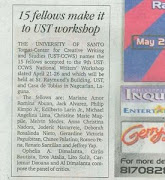
Congratulations! You have been selected as one of the fifteen fellows for the 11th IYAS Creative Writing Workshop to be held on April 25 - 30 at Balay Kalinungan, University of St. La Salle, Bacolod City.
The selection committee has awarded fellowships for emerging writers in English, Filipino, Bisaya and Hiligaynon in the genres of poetry, playwriting and short fiction among applicants nationwide.
IYAS fellows will be given a partial transportation subsidy of P 3,000 for those from Manila, P 1,500 from Cebu/Mindanao, and P 500 for those from Iloilo. Your board and lodging is free; however, we will not provide for your inland transportation. Upon arrival, please proceed to Balay Kalinungan where you will be staying for the duration of the workshop.
We will have a welcome dinner for the fellows and panelists on April 24, 6:30 PM at Dr. Coscolluela’s residence. There will be a van at Balay Kalinungan to bring you to the dinner venue. Departure will be at 6:00 PM.
The workshop proper will start at exactly 8:00 AM on April 25. It will consist of plenary sessions and small group interactions with the panelist/s in the afternoon. Fellows will be assigned to a group with a lead panelist according to the language and genre of works submitted.
If you have more questions, feel free to get in touch with me through phone or email.
Thank you.
Regards,
Dr. Gloria Fuentes
Project Coordinator
Creative Writing Workshop
Congratulations! You have been selected as one of the fifteen fellows for the 11th IYAS Creative Writing Workshop to be held on April 25 - 30 at Balay Kalinungan, University of St. La Salle, Bacolod City.
The selection committee has awarded fellowships for emerging writers in English, Filipino, Bisaya and Hiligaynon in the genres of poetry, playwriting and short fiction among applicants nationwide.
IYAS fellows will be given a partial transportation subsidy of P 3,000 for those from Manila, P 1,500 from Cebu/Mindanao, and P 500 for those from Iloilo. Your board and lodging is free; however, we will not provide for your inland transportation. Upon arrival, please proceed to Balay Kalinungan where you will be staying for the duration of the workshop.
We will have a welcome dinner for the fellows and panelists on April 24, 6:30 PM at Dr. Coscolluela’s residence. There will be a van at Balay Kalinungan to bring you to the dinner venue. Departure will be at 6:00 PM.
The workshop proper will start at exactly 8:00 AM on April 25. It will consist of plenary sessions and small group interactions with the panelist/s in the afternoon. Fellows will be assigned to a group with a lead panelist according to the language and genre of works submitted.
If you have more questions, feel free to get in touch with me through phone or email.
Thank you.
Regards,
Dr. Gloria Fuentes
Project Coordinator
Creative Writing Workshop
Tuesday, November 30, 2010
SANA FACEBOOK KA NA LANG, KALIKASAN!
Sana Facebook ka na lang kalikasan
para lagi kang bibisitahin, laging titingnan
at pahahalagahan.
Sana facebook ka na lang kalikasan
para di ka makararanas na mapabayaan,
saktan at iwanan.
Sana facebook ka na lang kalikasan
para kahit mag-send ng message
ang mga jejemon at mangamusta,gaya ng
“eow phou kalikasan, mouzta kqa nah phou?”
ay may maisasagot ka sa kanila na:
“Mabuti naman, ito masarap pa rin ang pakiramdam.”
Sana facebook ka na lang kalikasan
para kapag binisita at binuksan ka,
makikita sa application mo ang mga larong Farmville at Pet Society.
Maraming malilibang sa‘yo,
malilibang sa pagtatanim,pagbubungkal, at pag-aani.
Hindi ka hahayaang makalbo at maubusan ng pananim.
Sana facebook ka na lang kalikasan
tulad din sa Pet Society, aalagaan nang husto
ang mga hayop at hindi hahayaang maubos.
Sana facebook ka na lang kalikasan… sana…
Sana facebook ka na lang kalikasan
para kahit may mag-post sa wall mo
at magtanong kung ano ang nagiging problema mo,
ang maisasagot mo ay parang pang-miss universe na sagot,
“I don’t have any major major problem.. that’s all, thank you!”
Haaay…sarap sanang pakinggan.
Sana facebook ka na lang kalikasan
dahil nakakaawa ang kalagayan mo sa kasalukuyan,
tila isa ka sa mga hostage victim sa Quirino Grandstand
at naghihintay na lang ng kamatayan.
Sana facebook ka na lang, kalikasan!
para lagi kang bibisitahin, laging titingnan
at pahahalagahan.
Sana facebook ka na lang kalikasan
para di ka makararanas na mapabayaan,
saktan at iwanan.
Sana facebook ka na lang kalikasan
para kahit mag-send ng message
ang mga jejemon at mangamusta,gaya ng
“eow phou kalikasan, mouzta kqa nah phou?”
ay may maisasagot ka sa kanila na:
“Mabuti naman, ito masarap pa rin ang pakiramdam.”
Sana facebook ka na lang kalikasan
para kapag binisita at binuksan ka,
makikita sa application mo ang mga larong Farmville at Pet Society.
Maraming malilibang sa‘yo,
malilibang sa pagtatanim,pagbubungkal, at pag-aani.
Hindi ka hahayaang makalbo at maubusan ng pananim.
Sana facebook ka na lang kalikasan
tulad din sa Pet Society, aalagaan nang husto
ang mga hayop at hindi hahayaang maubos.
Sana facebook ka na lang kalikasan… sana…
Sana facebook ka na lang kalikasan
para kahit may mag-post sa wall mo
at magtanong kung ano ang nagiging problema mo,
ang maisasagot mo ay parang pang-miss universe na sagot,
“I don’t have any major major problem.. that’s all, thank you!”
Haaay…sarap sanang pakinggan.
Sana facebook ka na lang kalikasan
dahil nakakaawa ang kalagayan mo sa kasalukuyan,
tila isa ka sa mga hostage victim sa Quirino Grandstand
at naghihintay na lang ng kamatayan.
Sana facebook ka na lang, kalikasan!
Friday, November 19, 2010
Saturday, September 25, 2010
HOW SHOULD ONE READ A BOOK by Virginia Woolf
In the first place, I want to emphasise the note of interrogation at the end of my title. Even if I could answer the question for myself, the answer would apply only to me and not to you. The only advice, indeed, that one person can give another about reading is to take no advice, to follow your own instincts, to use your own reason, to come to your own conclusions. If this is agreed between us, then I feel at liberty to put forward a few ideas and suggestions because you will not allow them to fetter that independence which is the most important quality that a reader can possess. After all, what laws can be laid down about books? The battle of Waterloo was certainly fought on a certain day; but is Hamlet a better play than Lear? Nobody can say. Each must decide that question for himself. To admit authorities, however heavily furred and gowned, into our libraries and let them tell us how to read, what to read, what value to place upon what we read, is to destroy the spirit of freedom which is the breath of those sanctuaries. Everywhere else we may be bound by laws and conventions — there we have none.
But to enjoy freedom, if the platitude is pardonable, we have of course to control ourselves. We must not squander our powers, helplessly and ignorantly, squirting half the house in order to water a single rose-bush; we must train them, exactly and powerfully, here on the very spot. This, it may be, is one of the first difficulties that faces us in a library. What is “the very spot”? There may well seem to be nothing but a conglomeration and huddle of confusion. Poems and novels, histories and memoirs, dictionaries and blue-books; books written in all languages by men and women of all tempers, races, and ages jostle each other on the shelf. And outside the donkey brays, the women gossip at the pump, the colts gallop across the fields. Where are we to begin? How are we to bring order into this multitudinous chaos and so get the deepest and widest pleasure from what we read?
It is simple enough to say that since books have classes — fiction, biography, poetry — we should separate them and take from each what it is right that each should give us. Yet few people ask from books what books can give us. Most commonly we come to books with blurred and divided minds, asking of fiction that it shall be true, of poetry that it shall be false, of biography that it shall be flattering, of history that it shall enforce our own prejudices. If we could banish all such preconceptions when we read, that would be an admirable beginning. Do not dictate to your author; try to become him. Be his fellow-worker and accomplice. If you hang back, and reserve and criticise at first, you are preventing yourself from getting the fullest possible value from what you read. But if you open your mind as widely as possible, then signs and hints of almost imperceptible fineness, from the twist and turn of the first sentences, will bring you into the presence of a human being unlike any other. Steep yourself in this, acquaint yourself with this, and soon you will find that your author is giving you, or attempting to give you, something far more definite. The thirty-two chapters of a novel — if we consider how to read a novel first — are an attempt to make something as formed and controlled as a building: but words are more impalpable than bricks; reading is a longer and more complicated process than seeing. Perhaps the quickest way to understand the elements of what a novelist is doing is not to read, but to write; to make your own experiment with the dangers and difficulties of words. Recall, then, some event that has left a distinct impression on you — how at the corner of the street, perhaps, you passed two people talking. A tree shook; an electric light danced; the tone of the talk was comic, but also tragic; a whole vision, an entire conception, seemed contained in that moment.
But when you attempt to reconstruct it in words, you will find that it breaks into a thousand conflicting impressions. Some must be subdued; others emphasised; in the process you will lose, probably, all grasp upon the emotion itself. Then turn from your blurred and littered pages to the opening pages of some great novelist — Defoe, Jane Austen, Hardy. Now you will be better able to appreciate their mastery. It is not merely that we are in the presence of a different person — Defoe, Jane Austen, or Thomas Hardy — but that we are living in a different world. Here, in Robinson Crusoe, we are trudging a plain high road; one thing happens after another; the fact and the order of the fact is enough. But if the open air and adventure mean everything to Defoe they mean nothing to Jane Austen. Hers is the drawing-room, and people talking, and by the many mirrors of their talk revealing their characters. And if, when we have accustomed ourselves to the drawing-room and its reflections, we turn to Hardy, we are once more spun round. The moors are round us and the stars are above our heads. The other side of the mind is now exposed — the dark side that comes uppermost in solitude, not the light side that shows in company. Our relations are not towards people, but towards Nature and destiny. Yet different as these worlds are, each is consistent with itself. The maker of each is careful to observe the laws of his own perspective, and however great a strain they may put upon us they will never confuse us, as lesser writers so frequently do, by introducing two different kinds of reality into the same book. Thus to go from one great novelist to another — from Jane Austen to Hardy, from Peacock to Trollope, from Scott to Meredith — is to be wrenched and uprooted; to be thrown this way and then that. To read a novel is a difficult and complex art. You must be capable not only of great fineness of perception, but of great boldness of imagination if you are going to make use of all that the novelist — the great artist — gives you.
But a glance at the heterogeneous company on the shelf will show you that writers are very seldom “great artists”; far more often a book makes no claim to be a work of art at all. These biographies and autobiographies, for example, lives of great men, of men long dead and forgotten, that stand cheek by jowl with the novels and poems, are we to refuse to read them because they are not “art”? Or shall we read them, but read them in a different way, with a different aim? Shall we read them in the first place to satisfy that curiosity which possesses us sometimes when in the evening we linger in front of a house where the lights are lit and the blinds not yet drawn, and each floor of the house shows us a different section of human life in being? Then we are consumed with curiosity about the lives of these people — the servants gossiping, the gentlemen dining, the girl dressing for a party, the old woman at the window with her knitting. Who are they, what are they, what are their names, their occupations, their thoughts, and adventures?
Biographies and memoirs answer such questions, light up innumerable such houses; they show us people going about their daily affairs, toiling, failing, succeeding, eating, hating, loving, until they die. And sometimes as we watch, the house fades and the iron railings vanish and we are out at sea; we are hunting, sailing, fighting; we are among savages and soldiers; we are taking part in great campaigns. Or if we like to stay here in England, in London, still the scene changes; the street narrows; the house becomes small, cramped, diamond-paned, and malodorous. We see a poet, Donne, driven from such a house because the walls were so thin that when the children cried their voices cut through them. We can follow him, through the paths that lie in the pages of books, to Twickenham; to Lady Bedford’s Park, a famous meeting-ground for nobles and poets; and then turn our steps to Wilton, the great house under the downs, and hear Sidney read the Arcadia to his sister; and ramble among the very marshes and see the very herons that figure in that famous romance; and then again travel north with that other Lady Pembroke, Anne Clifford, to her wild moors, or plunge into the city and control our merriment at the sight of Gabriel Harvey in his black velvet suit arguing about poetry with Spenser. Nothing is more fascinating than to grope and stumble in the alternate darkness and splendour of Elizabethan London. But there is no staying there. The Temples and the Swifts, the Harleys and the St. Johns beckon us on; hour upon hour can be spent disentangling their quarrels and deciphering their characters; and when we tire of them we can stroll on, past a lady in black wearing diamonds, to Samuel Johnson and Goldsmith and Garrick; or cross the channel, if we like, and meet Voltaire and Diderot, Madame du Deffand; and so back to England and Twickenham — how certain places repeat themselves and certain names!— where Lady Bedford had her Park once and Pope lived later, to Walpole’s home at Strawberry Hill. But Walpole introduces us to such a swarm of new acquaintances, there are so many houses to visit and bells to ring that we may well hesitate for a moment, on the Miss Berrys’ doorstep, for example, when behold, up comes Thackeray; he is the friend of the woman whom Walpole loved; so that merely by going from friend to friend, from garden to garden, from house to house, we have passed from one end of English literature to another and wake to find ourselves here again in the present, if we can so differentiate this moment from all that have gone before. This, then, is one of the ways in which we can read these lives and letters; we can make them light up the many windows of the past; we can watch the famous dead in their familiar habits and fancy sometimes that we are very close and can surprise their secrets, and sometimes we may pull out a play or a poem that they have written and see whether it reads differently in the presence of the author. But this again rouses other questions. How far, we must ask ourselves, is a book influenced by its writer’s life — how far is it safe to let the man interpret the writer? How far shall we resist or give way to the sympathies and antipathies that the man himself rouses in us — so sensitive are words, so receptive of the character of the author? These are questions that press upon us when we read lives and letters, and we must answer them for ourselves, for nothing can be more fatal than to be guided by the preferences of others in a matter so personal.
But also we can read such books with another aim, not to throw light on literature, not to become familiar with famous people, but to refresh and exercise our own creative powers. Is there not an open window on the right hand of the bookcase? How delightful to stop reading and look out! How stimulating the scene is, in its unconsciousness, its irrelevance, its perpetual movement — the colts galloping round the field, the woman filling her pail at the well, the donkey throwing back his head and emitting his long, acrid moan. The greater part of any library is nothing but the record of such fleeting moments in the lives of men, women, and donkeys. Every literature, as it grows old, has its rubbish-heap, its record of vanished moments and forgotten lives told in faltering and feeble accents that have perished. But if you give yourself up to the delight of rubbish-reading you will be surprised, indeed you will be overcome, by the relics of human life that have been cast out to moulder. It may be one letter — but what a vision it gives! It may be a few sentences — but what vistas they suggest! Sometimes a whole story will come together with such beautiful humour and pathos and completeness that it seems as if a great novelist had been at work, yet it is only an old actor, Tate Wilkinson, remembering the strange story of Captain Jones; it is only a young subaltern serving under Arthur Wellesley and falling in love with a pretty girl at Lisbon; it is only Maria Allen letting fall her sewing in the empty drawing-room and sighing how she wishes she had taken Dr. Burney’s good advice and had never eloped with her Rishy. None of this has any value; it is negligible in the extreme; yet how absorbing it is now and again to go through the rubbish-heaps and find rings and scissors and broken noses buried in the huge past and try to piece them together while the colt gallops round the field, the woman fills her pail at the well, and the donkey brays.
But we tire of rubbish-reading in the long run. We tire of searching for what is needed to complete the half-truth which is all that the Wilkinsons, the Bunburys, and the Maria Allens are able to offer us. They had not the artist’s power of mastering and eliminating; they could not tell the whole truth even about their own lives; they have disfigured the story that might have been so shapely. Facts are all that they can offer us, and facts are a very inferior form of fiction. Thus the desire grows upon us to have done with half-statements and approximations; to cease from searching out the minute shades of human character, to enjoy the greater abstractness, the purer truth of fiction. Thus we create the mood, intense and generalised, unaware of detail, but stressed by some regular, recurrent beat, whose natural expression is poetry; and that is the time to read poetry . . . when we are almost able to write it.
Western wind, when wilt thou blow?
The small rain down can rain.
Christ, if my love were in my arms,
And I in my bed again!
The impact of poetry is so hard and direct that for the moment there is no other sensation except that of the poem itself. What profound depths we visit then — how sudden and complete is our immersion! There is nothing here to catch hold of; nothing to stay us in our flight. The illusion of fiction is gradual; its effects are prepared; but who when they read these four lines stops to ask who wrote them, or conjures up the thought of Donne’s house or Sidney’s secretary; or enmeshes them in the intricacy of the past and the succession of generations? The poet is always our contemporary. Our being for the moment is centred and constricted, as in any violent shock of personal emotion. Afterwards, it is true, the sensation begins to spread in wider rings through our minds; remoter senses are reached; these begin to sound and to comment and we are aware of echoes and reflections. The intensity of poetry covers an immense range of emotion. We have only to compare the force and directness of
I shall fall like a tree, and find my grave,
Only remembering that I grieve,
with the wavering modulation of
Minutes are numbered by the fall of sands,
As by an hour glass; the span of time
Doth waste us to our graves, and we look on it;
An age of pleasure, revelled out, comes home
At last, and ends in sorrow; but the life,
Weary of riot, numbers every sand,
Wailing in sighs, until the last drop down,
So to conclude calamity in rest,
or place the meditative calm of
whether we be young or old,
Our destiny, our being’s heart and home,
Is with infinitude, and only there;
With hope it is, hope that can never die,
Effort, and expectation, and desire,
And something evermore about to be,
beside the complete and inexhaustible loveliness of
The moving Moon went up the sky,
And nowhere did abide:
Softly she was going up,
And a star or two beside —
or the splendid fantasy of
And the woodland haunter
Shall not cease to saunter
When, far down some glade,
Of the great world’s burning,
One soft flame upturning
Seems, to his discerning,
Crocus in the shade,
to bethink us of the varied art of the poet; his power to make us at once actors and spectators; his power to run his hand into character as if it were a glove, and be Falstaff or Lear; his power to condense, to widen, to state, once and for ever.
“We have only to compare”— with those words the cat is out of the bag, and the true complexity of reading is admitted. The first process, to receive impressions with the utmost understanding, is only half the process of reading; it must be completed, if we are to get the whole pleasure from a book, by another. We must pass judgment upon these multitudinous impressions; we must make of these fleeting shapes one that is hard and lasting. But not directly. Wait for the dust of reading to settle; for the conflict and the questioning to die down; walk, talk, pull the dead petals from a rose, or fall asleep. Then suddenly without our willing it, for it is thus that Nature undertakes these transitions, the book will return, but differently. It will float to the top of the mind as a whole. And the book as a whole is different from the book received currently in separate phrases. Details now fit themselves into their places. We see the shape from start to finish; it is a barn, a pigsty, or a cathedral. Now then we can compare book with book as we compare building with building. But this act of comparison means that our attitude has changed; we are no longer the friends of the writer, but his judges; and just as we cannot be too sympathetic as friends, so as judges we cannot be too severe. Are they not criminals, books that have wasted our time and sympathy; are they not the most insidious enemies of society, corrupters, defilers, the writers of false books, faked books, books that fill the air with decay and disease? Let us then be severe in our judgments; let us compare each book with the greatest of its kind. There they hang in the mind the shapes of the books we have read solidified by the judgments we have passed on them — Robinson Crusoe, Emma, The Return of the Native. Compare the novels with these — even the latest and least of novels has a right to be judged with the best. And so with poetry — when the intoxication of rhythm has died down and the splendour of words has faded, a visionary shape will return to us and this must be compared with Lear, with Phèdre, with The Prelude; or if not with these, with whatever is the best or seems to us to be the best in its own kind. And we may be sure that the newness of new poetry and fiction is its most superficial quality and that we have only to alter slightly, not to recast, the standards by which we have judged the old.
It would be foolish, then, to pretend that the second part of reading, to judge, to compare, is as simple as the first — to open the mind wide to the fast flocking of innumerable impressions. To continue reading without the book before you, to hold one shadow-shape against another, to have read widely enough and with enough understanding to make such comparisons alive and illuminating — that is difficult; it is still more difficult to press further and to say, “Not only is the book of this sort, but it is of this value; here it fails; here it succeeds; this is bad; that is good”. To carry out this part of a reader’s duty needs such imagination, insight, and learning that it is hard to conceive any one mind sufficiently endowed; impossible for the most self-confident to find more than the seeds of such powers in himself. Would it not be wiser, then, to remit this part of reading and to allow the critics, the gowned and furred authorities of the library, to decide the question of the book’s absolute value for us? Yet how impossible! We may stress the value of sympathy; we may try to sink our identity as we read. But we know that we cannot sympathise wholly or immerse ourselves wholly; there is always a demon in us who whispers, “I hate, I love”, and we cannot silence him. Indeed, it is precisely because we hate and we love that our relation with the poets and novelists is so intimate that we find the presence of another person intolerable. And even if the results are abhorrent and our judgments are wrong, still our taste, the nerve of sensation that sends shocks through us, is our chief illuminant; we learn through feeling; we cannot suppress our own idiosyncrasy without impoverishing it. But as time goes on perhaps we can train our taste; perhaps we can make it submit to some control. When it has fed greedily and lavishly upon books of all sorts — poetry, fiction, history, biography — and has stopped reading and looked for long spaces upon the variety, the incongruity of the living world, we shall find that it is changing a little; it is not so greedy, it is more reflective. It will begin to bring us not merely judgments on particular books, but it will tell us that there is a quality common to certain books. Listen, it will say, what shall we call THIS? And it will read us perhaps Lear and then perhaps the Agamemnon in order to bring out that common quality. Thus, with our taste to guide us, we shall venture beyond the particular book in search of qualities that group books together; we shall give them names and thus frame a rule that brings order into our perceptions. We shall gain a further and a rarer pleasure from that discrimination. But as a rule only lives when it is perpetually broken by contact with the books themselves — nothing is easier and more stultifying than to make rules which exist out of touch with facts, in a vacuum — now at last, in order to steady ourselves in this difficult attempt, it may be well to turn to the very rare writers who are able to enlighten us upon literature as an art. Coleridge and Dryden and Johnson, in their considered criticism, the poets and novelists themselves in their considered sayings, are often surprisingly revelant; they light up and solidify the vague ideas that have been tumbling in the misty depths of our minds. But they are only able to help us if we come to them laden with questions and suggestions won honestly in the course of our own reading. They can do nothing for us if we herd ourselves under their authority and lie down like sheep in the shade of a hedge. We can only understand their ruling when it comes in conflict with our own and vanquishes it.
If this is so, if to read a book as it should be read calls for the rarest qualities of imagination, insight, and judgment, you may perhaps conclude that literature is a very complex art and that it is unlikely that we shall be able, even after a lifetime of reading, to make any valuable contribution to its criticism. We must remain readers; we shall not put on the further glory that belongs to those rare beings who are also critics. But still we have our responsibilities as readers and even our importance. The standards we raise and the judgments we pass steal into the air and become part of the atmosphere which writers breathe as they work. An influence is created which tells upon them even if it never finds its way into print. And that influence, if it were well instructed, vigorous and individual and sincere, might be of great value now when criticism is necessarily in abeyance; when books pass in review like the procession of animals in a shooting gallery, and the critic has only one second in which to load and aim and shoot and may well be pardoned if he mistakes rabbits for tigers, eagles for barndoor fowls, or misses altogether and wastes his shot upon some peaceful cow grazing in a further field. If behind the erratic gunfire of the press the author felt that there was another kind of criticism, the opinion of people reading for the love of reading, slowly and unprofessionally, and judging with great sympathy and yet with great severity, might this not improve the quality of his work? And if by our means books were to become stronger, richer, and more varied, that would be an end worth reaching.
Yet who reads to bring about an end, however desirable? Are there not some pursuits that we practise because they are good in themselves, and some pleasures that are final? And is not this among them? I have sometimes dreamt, at least, that when the Day of Judgment dawns and the great conquerors and lawyers and statesmen come to receive their rewards — their crowns, their laurels, their names carved indelibly upon imperishable marble — the Almighty will turn to Peter and will say, not without a certain envy when he sees us coming with our books under our arms, “Look, these need no reward. We have nothing to give them here. They have loved reading.”
But to enjoy freedom, if the platitude is pardonable, we have of course to control ourselves. We must not squander our powers, helplessly and ignorantly, squirting half the house in order to water a single rose-bush; we must train them, exactly and powerfully, here on the very spot. This, it may be, is one of the first difficulties that faces us in a library. What is “the very spot”? There may well seem to be nothing but a conglomeration and huddle of confusion. Poems and novels, histories and memoirs, dictionaries and blue-books; books written in all languages by men and women of all tempers, races, and ages jostle each other on the shelf. And outside the donkey brays, the women gossip at the pump, the colts gallop across the fields. Where are we to begin? How are we to bring order into this multitudinous chaos and so get the deepest and widest pleasure from what we read?
It is simple enough to say that since books have classes — fiction, biography, poetry — we should separate them and take from each what it is right that each should give us. Yet few people ask from books what books can give us. Most commonly we come to books with blurred and divided minds, asking of fiction that it shall be true, of poetry that it shall be false, of biography that it shall be flattering, of history that it shall enforce our own prejudices. If we could banish all such preconceptions when we read, that would be an admirable beginning. Do not dictate to your author; try to become him. Be his fellow-worker and accomplice. If you hang back, and reserve and criticise at first, you are preventing yourself from getting the fullest possible value from what you read. But if you open your mind as widely as possible, then signs and hints of almost imperceptible fineness, from the twist and turn of the first sentences, will bring you into the presence of a human being unlike any other. Steep yourself in this, acquaint yourself with this, and soon you will find that your author is giving you, or attempting to give you, something far more definite. The thirty-two chapters of a novel — if we consider how to read a novel first — are an attempt to make something as formed and controlled as a building: but words are more impalpable than bricks; reading is a longer and more complicated process than seeing. Perhaps the quickest way to understand the elements of what a novelist is doing is not to read, but to write; to make your own experiment with the dangers and difficulties of words. Recall, then, some event that has left a distinct impression on you — how at the corner of the street, perhaps, you passed two people talking. A tree shook; an electric light danced; the tone of the talk was comic, but also tragic; a whole vision, an entire conception, seemed contained in that moment.
But when you attempt to reconstruct it in words, you will find that it breaks into a thousand conflicting impressions. Some must be subdued; others emphasised; in the process you will lose, probably, all grasp upon the emotion itself. Then turn from your blurred and littered pages to the opening pages of some great novelist — Defoe, Jane Austen, Hardy. Now you will be better able to appreciate their mastery. It is not merely that we are in the presence of a different person — Defoe, Jane Austen, or Thomas Hardy — but that we are living in a different world. Here, in Robinson Crusoe, we are trudging a plain high road; one thing happens after another; the fact and the order of the fact is enough. But if the open air and adventure mean everything to Defoe they mean nothing to Jane Austen. Hers is the drawing-room, and people talking, and by the many mirrors of their talk revealing their characters. And if, when we have accustomed ourselves to the drawing-room and its reflections, we turn to Hardy, we are once more spun round. The moors are round us and the stars are above our heads. The other side of the mind is now exposed — the dark side that comes uppermost in solitude, not the light side that shows in company. Our relations are not towards people, but towards Nature and destiny. Yet different as these worlds are, each is consistent with itself. The maker of each is careful to observe the laws of his own perspective, and however great a strain they may put upon us they will never confuse us, as lesser writers so frequently do, by introducing two different kinds of reality into the same book. Thus to go from one great novelist to another — from Jane Austen to Hardy, from Peacock to Trollope, from Scott to Meredith — is to be wrenched and uprooted; to be thrown this way and then that. To read a novel is a difficult and complex art. You must be capable not only of great fineness of perception, but of great boldness of imagination if you are going to make use of all that the novelist — the great artist — gives you.
But a glance at the heterogeneous company on the shelf will show you that writers are very seldom “great artists”; far more often a book makes no claim to be a work of art at all. These biographies and autobiographies, for example, lives of great men, of men long dead and forgotten, that stand cheek by jowl with the novels and poems, are we to refuse to read them because they are not “art”? Or shall we read them, but read them in a different way, with a different aim? Shall we read them in the first place to satisfy that curiosity which possesses us sometimes when in the evening we linger in front of a house where the lights are lit and the blinds not yet drawn, and each floor of the house shows us a different section of human life in being? Then we are consumed with curiosity about the lives of these people — the servants gossiping, the gentlemen dining, the girl dressing for a party, the old woman at the window with her knitting. Who are they, what are they, what are their names, their occupations, their thoughts, and adventures?
Biographies and memoirs answer such questions, light up innumerable such houses; they show us people going about their daily affairs, toiling, failing, succeeding, eating, hating, loving, until they die. And sometimes as we watch, the house fades and the iron railings vanish and we are out at sea; we are hunting, sailing, fighting; we are among savages and soldiers; we are taking part in great campaigns. Or if we like to stay here in England, in London, still the scene changes; the street narrows; the house becomes small, cramped, diamond-paned, and malodorous. We see a poet, Donne, driven from such a house because the walls were so thin that when the children cried their voices cut through them. We can follow him, through the paths that lie in the pages of books, to Twickenham; to Lady Bedford’s Park, a famous meeting-ground for nobles and poets; and then turn our steps to Wilton, the great house under the downs, and hear Sidney read the Arcadia to his sister; and ramble among the very marshes and see the very herons that figure in that famous romance; and then again travel north with that other Lady Pembroke, Anne Clifford, to her wild moors, or plunge into the city and control our merriment at the sight of Gabriel Harvey in his black velvet suit arguing about poetry with Spenser. Nothing is more fascinating than to grope and stumble in the alternate darkness and splendour of Elizabethan London. But there is no staying there. The Temples and the Swifts, the Harleys and the St. Johns beckon us on; hour upon hour can be spent disentangling their quarrels and deciphering their characters; and when we tire of them we can stroll on, past a lady in black wearing diamonds, to Samuel Johnson and Goldsmith and Garrick; or cross the channel, if we like, and meet Voltaire and Diderot, Madame du Deffand; and so back to England and Twickenham — how certain places repeat themselves and certain names!— where Lady Bedford had her Park once and Pope lived later, to Walpole’s home at Strawberry Hill. But Walpole introduces us to such a swarm of new acquaintances, there are so many houses to visit and bells to ring that we may well hesitate for a moment, on the Miss Berrys’ doorstep, for example, when behold, up comes Thackeray; he is the friend of the woman whom Walpole loved; so that merely by going from friend to friend, from garden to garden, from house to house, we have passed from one end of English literature to another and wake to find ourselves here again in the present, if we can so differentiate this moment from all that have gone before. This, then, is one of the ways in which we can read these lives and letters; we can make them light up the many windows of the past; we can watch the famous dead in their familiar habits and fancy sometimes that we are very close and can surprise their secrets, and sometimes we may pull out a play or a poem that they have written and see whether it reads differently in the presence of the author. But this again rouses other questions. How far, we must ask ourselves, is a book influenced by its writer’s life — how far is it safe to let the man interpret the writer? How far shall we resist or give way to the sympathies and antipathies that the man himself rouses in us — so sensitive are words, so receptive of the character of the author? These are questions that press upon us when we read lives and letters, and we must answer them for ourselves, for nothing can be more fatal than to be guided by the preferences of others in a matter so personal.
But also we can read such books with another aim, not to throw light on literature, not to become familiar with famous people, but to refresh and exercise our own creative powers. Is there not an open window on the right hand of the bookcase? How delightful to stop reading and look out! How stimulating the scene is, in its unconsciousness, its irrelevance, its perpetual movement — the colts galloping round the field, the woman filling her pail at the well, the donkey throwing back his head and emitting his long, acrid moan. The greater part of any library is nothing but the record of such fleeting moments in the lives of men, women, and donkeys. Every literature, as it grows old, has its rubbish-heap, its record of vanished moments and forgotten lives told in faltering and feeble accents that have perished. But if you give yourself up to the delight of rubbish-reading you will be surprised, indeed you will be overcome, by the relics of human life that have been cast out to moulder. It may be one letter — but what a vision it gives! It may be a few sentences — but what vistas they suggest! Sometimes a whole story will come together with such beautiful humour and pathos and completeness that it seems as if a great novelist had been at work, yet it is only an old actor, Tate Wilkinson, remembering the strange story of Captain Jones; it is only a young subaltern serving under Arthur Wellesley and falling in love with a pretty girl at Lisbon; it is only Maria Allen letting fall her sewing in the empty drawing-room and sighing how she wishes she had taken Dr. Burney’s good advice and had never eloped with her Rishy. None of this has any value; it is negligible in the extreme; yet how absorbing it is now and again to go through the rubbish-heaps and find rings and scissors and broken noses buried in the huge past and try to piece them together while the colt gallops round the field, the woman fills her pail at the well, and the donkey brays.
But we tire of rubbish-reading in the long run. We tire of searching for what is needed to complete the half-truth which is all that the Wilkinsons, the Bunburys, and the Maria Allens are able to offer us. They had not the artist’s power of mastering and eliminating; they could not tell the whole truth even about their own lives; they have disfigured the story that might have been so shapely. Facts are all that they can offer us, and facts are a very inferior form of fiction. Thus the desire grows upon us to have done with half-statements and approximations; to cease from searching out the minute shades of human character, to enjoy the greater abstractness, the purer truth of fiction. Thus we create the mood, intense and generalised, unaware of detail, but stressed by some regular, recurrent beat, whose natural expression is poetry; and that is the time to read poetry . . . when we are almost able to write it.
Western wind, when wilt thou blow?
The small rain down can rain.
Christ, if my love were in my arms,
And I in my bed again!
The impact of poetry is so hard and direct that for the moment there is no other sensation except that of the poem itself. What profound depths we visit then — how sudden and complete is our immersion! There is nothing here to catch hold of; nothing to stay us in our flight. The illusion of fiction is gradual; its effects are prepared; but who when they read these four lines stops to ask who wrote them, or conjures up the thought of Donne’s house or Sidney’s secretary; or enmeshes them in the intricacy of the past and the succession of generations? The poet is always our contemporary. Our being for the moment is centred and constricted, as in any violent shock of personal emotion. Afterwards, it is true, the sensation begins to spread in wider rings through our minds; remoter senses are reached; these begin to sound and to comment and we are aware of echoes and reflections. The intensity of poetry covers an immense range of emotion. We have only to compare the force and directness of
I shall fall like a tree, and find my grave,
Only remembering that I grieve,
with the wavering modulation of
Minutes are numbered by the fall of sands,
As by an hour glass; the span of time
Doth waste us to our graves, and we look on it;
An age of pleasure, revelled out, comes home
At last, and ends in sorrow; but the life,
Weary of riot, numbers every sand,
Wailing in sighs, until the last drop down,
So to conclude calamity in rest,
or place the meditative calm of
whether we be young or old,
Our destiny, our being’s heart and home,
Is with infinitude, and only there;
With hope it is, hope that can never die,
Effort, and expectation, and desire,
And something evermore about to be,
beside the complete and inexhaustible loveliness of
The moving Moon went up the sky,
And nowhere did abide:
Softly she was going up,
And a star or two beside —
or the splendid fantasy of
And the woodland haunter
Shall not cease to saunter
When, far down some glade,
Of the great world’s burning,
One soft flame upturning
Seems, to his discerning,
Crocus in the shade,
to bethink us of the varied art of the poet; his power to make us at once actors and spectators; his power to run his hand into character as if it were a glove, and be Falstaff or Lear; his power to condense, to widen, to state, once and for ever.
“We have only to compare”— with those words the cat is out of the bag, and the true complexity of reading is admitted. The first process, to receive impressions with the utmost understanding, is only half the process of reading; it must be completed, if we are to get the whole pleasure from a book, by another. We must pass judgment upon these multitudinous impressions; we must make of these fleeting shapes one that is hard and lasting. But not directly. Wait for the dust of reading to settle; for the conflict and the questioning to die down; walk, talk, pull the dead petals from a rose, or fall asleep. Then suddenly without our willing it, for it is thus that Nature undertakes these transitions, the book will return, but differently. It will float to the top of the mind as a whole. And the book as a whole is different from the book received currently in separate phrases. Details now fit themselves into their places. We see the shape from start to finish; it is a barn, a pigsty, or a cathedral. Now then we can compare book with book as we compare building with building. But this act of comparison means that our attitude has changed; we are no longer the friends of the writer, but his judges; and just as we cannot be too sympathetic as friends, so as judges we cannot be too severe. Are they not criminals, books that have wasted our time and sympathy; are they not the most insidious enemies of society, corrupters, defilers, the writers of false books, faked books, books that fill the air with decay and disease? Let us then be severe in our judgments; let us compare each book with the greatest of its kind. There they hang in the mind the shapes of the books we have read solidified by the judgments we have passed on them — Robinson Crusoe, Emma, The Return of the Native. Compare the novels with these — even the latest and least of novels has a right to be judged with the best. And so with poetry — when the intoxication of rhythm has died down and the splendour of words has faded, a visionary shape will return to us and this must be compared with Lear, with Phèdre, with The Prelude; or if not with these, with whatever is the best or seems to us to be the best in its own kind. And we may be sure that the newness of new poetry and fiction is its most superficial quality and that we have only to alter slightly, not to recast, the standards by which we have judged the old.
It would be foolish, then, to pretend that the second part of reading, to judge, to compare, is as simple as the first — to open the mind wide to the fast flocking of innumerable impressions. To continue reading without the book before you, to hold one shadow-shape against another, to have read widely enough and with enough understanding to make such comparisons alive and illuminating — that is difficult; it is still more difficult to press further and to say, “Not only is the book of this sort, but it is of this value; here it fails; here it succeeds; this is bad; that is good”. To carry out this part of a reader’s duty needs such imagination, insight, and learning that it is hard to conceive any one mind sufficiently endowed; impossible for the most self-confident to find more than the seeds of such powers in himself. Would it not be wiser, then, to remit this part of reading and to allow the critics, the gowned and furred authorities of the library, to decide the question of the book’s absolute value for us? Yet how impossible! We may stress the value of sympathy; we may try to sink our identity as we read. But we know that we cannot sympathise wholly or immerse ourselves wholly; there is always a demon in us who whispers, “I hate, I love”, and we cannot silence him. Indeed, it is precisely because we hate and we love that our relation with the poets and novelists is so intimate that we find the presence of another person intolerable. And even if the results are abhorrent and our judgments are wrong, still our taste, the nerve of sensation that sends shocks through us, is our chief illuminant; we learn through feeling; we cannot suppress our own idiosyncrasy without impoverishing it. But as time goes on perhaps we can train our taste; perhaps we can make it submit to some control. When it has fed greedily and lavishly upon books of all sorts — poetry, fiction, history, biography — and has stopped reading and looked for long spaces upon the variety, the incongruity of the living world, we shall find that it is changing a little; it is not so greedy, it is more reflective. It will begin to bring us not merely judgments on particular books, but it will tell us that there is a quality common to certain books. Listen, it will say, what shall we call THIS? And it will read us perhaps Lear and then perhaps the Agamemnon in order to bring out that common quality. Thus, with our taste to guide us, we shall venture beyond the particular book in search of qualities that group books together; we shall give them names and thus frame a rule that brings order into our perceptions. We shall gain a further and a rarer pleasure from that discrimination. But as a rule only lives when it is perpetually broken by contact with the books themselves — nothing is easier and more stultifying than to make rules which exist out of touch with facts, in a vacuum — now at last, in order to steady ourselves in this difficult attempt, it may be well to turn to the very rare writers who are able to enlighten us upon literature as an art. Coleridge and Dryden and Johnson, in their considered criticism, the poets and novelists themselves in their considered sayings, are often surprisingly revelant; they light up and solidify the vague ideas that have been tumbling in the misty depths of our minds. But they are only able to help us if we come to them laden with questions and suggestions won honestly in the course of our own reading. They can do nothing for us if we herd ourselves under their authority and lie down like sheep in the shade of a hedge. We can only understand their ruling when it comes in conflict with our own and vanquishes it.
If this is so, if to read a book as it should be read calls for the rarest qualities of imagination, insight, and judgment, you may perhaps conclude that literature is a very complex art and that it is unlikely that we shall be able, even after a lifetime of reading, to make any valuable contribution to its criticism. We must remain readers; we shall not put on the further glory that belongs to those rare beings who are also critics. But still we have our responsibilities as readers and even our importance. The standards we raise and the judgments we pass steal into the air and become part of the atmosphere which writers breathe as they work. An influence is created which tells upon them even if it never finds its way into print. And that influence, if it were well instructed, vigorous and individual and sincere, might be of great value now when criticism is necessarily in abeyance; when books pass in review like the procession of animals in a shooting gallery, and the critic has only one second in which to load and aim and shoot and may well be pardoned if he mistakes rabbits for tigers, eagles for barndoor fowls, or misses altogether and wastes his shot upon some peaceful cow grazing in a further field. If behind the erratic gunfire of the press the author felt that there was another kind of criticism, the opinion of people reading for the love of reading, slowly and unprofessionally, and judging with great sympathy and yet with great severity, might this not improve the quality of his work? And if by our means books were to become stronger, richer, and more varied, that would be an end worth reaching.
Yet who reads to bring about an end, however desirable? Are there not some pursuits that we practise because they are good in themselves, and some pleasures that are final? And is not this among them? I have sometimes dreamt, at least, that when the Day of Judgment dawns and the great conquerors and lawyers and statesmen come to receive their rewards — their crowns, their laurels, their names carved indelibly upon imperishable marble — the Almighty will turn to Peter and will say, not without a certain envy when he sees us coming with our books under our arms, “Look, these need no reward. We have nothing to give them here. They have loved reading.”
Subscribe to:
Posts (Atom)